Leading Teams Through AI Change with Gregg Brown

When a Leader’s Good Intentions Reinforce the AI Divide at Work
By Gregg Brown
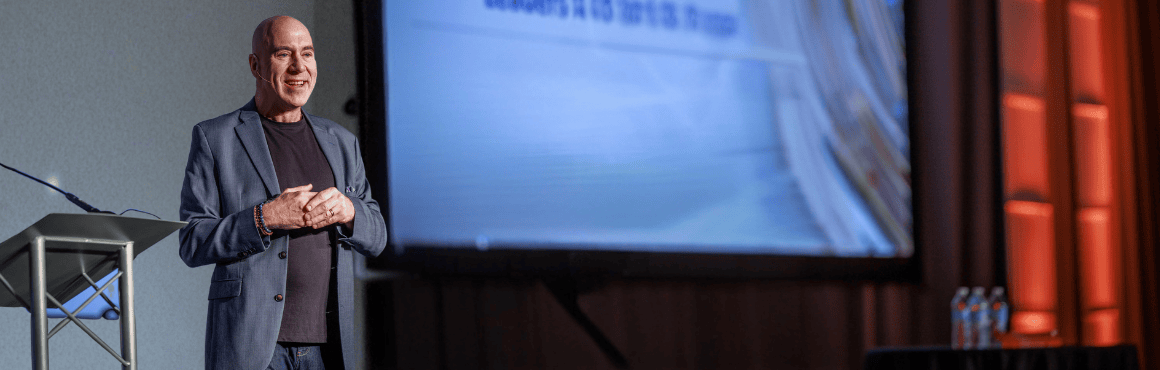
NSB speaker Gregg Brown
Gregg Brown globally recognized change strategist, bestselling author of Spark Action: How to Lead Change That Matters, and current PhD researcher on AI’s impact on organizational leadership, is asking the question most leaders haven’t thought to ask yet: are your good intentions around AI actually making things worse? In this timely article drawn from his PhD research, Gregg applies the work of German sociologist Norbert Elias to reveal how everyday leadership decisions are quietly creating AI insiders and outsiders in today’s workplaces — and why closing that divide is one of the most urgent leadership challenges of our time.
With clients ranging from Johnson & Johnson, TD Bank, and Suncor to the UN, Habitat for Humanity, and the CDC, and ideas featured in Forbes, Newsweek, and Rolling Stone, Gregg brings a rare blend of academic rigour and practical storytelling to every stage. Available for keynotes, leadership workshops, and future-of-work sessions across Canada and internationally. ______
Here are five common ways leaders unintentionally reinforce the insider/outsider dynamic:
Using AI as a shield for unpopular decisions
Leaders can be tempted to say “the system recommended this” when making tough calls on performance, schedules, or opportunities. This shifts responsibility from the human to the tool and makes decisions feel like people can’t question them.
Assigning tech work based on age assumptions
Asking younger employees to “handle the tech” while excluding older employees from pilots or advanced training may be perceived as efficient, but it subtly labels younger workers as helpers instead of strategists, and older workers as dependent on others instead of being capable. Both groups end up confined to narrow identities.
Creating a new tech elite
A small group of “AI champions” can quietly become gatekeepers of knowledge, influence, and opportunity. Over time, this concentrates power and makes everyone else, regardless of age dependent.
Treating someone’s ability with AI as an example of leadership potential
When comfort with AI tools is taken as proof of change agility or readiness to lead, other critical leadership capabilities such as judgment, empathy, and the ability to strategically think can be undervalued. More cautious or questioning voices risk being seen as sceptical late adopters and not eager to use AI or other technology.
Explaining hesitation as personal resistance
Comments like “Some people are good with change. Some people don’t like change,” are inaccurate and personalize what we know is a natural response when we encounter uncertainty. Ethical concerns, anxiety, or fear of failure often get labelled by others (and ourselves), as personal flaws, positioning some employees as obstacles instead of learners willing to engage.
The leadership takeaway:
The more technology can do, the more intentional leaders must be about how people experience the technology, have access to learning, and still have human connection. Small daily choices that leaders do determine whether AI includes people or excludes.
About The Author
Gregg Brown | Award-Winning Change Strategist on Building Future Ready Cultures
Gregg Brown is a globally recognized change and future of work expert and best-selling author empowering organizations to thrive in the future of work. He has spoken on hundreds of stages and engaged thousands of individuals in some of the world’s leading organizations: Fortune 500 companies, such as Johnson & Johnson, TD Bank, and Suncor through to governments, associations, and humanitarian organizations worldwide, including the UN, Habitat for Humanity and the CDC. His ideas are in Forbes, Newsweek, Rolling Stone, and Entrepreneur, and numerous HR publications.
Gregg’s book, Spark Action: How to Lead Change That Matters was recommended as one of the top thought-leader books to read by Thinkers360 and became an Amazon #1 Bestseller.
With a Master’s of Social Science degree from the University of Leicester in the UK, his Project Management Professional Designation (PMP) and as an associate member of the American Psychological Association, Gregg brings a unique blend of a practical insights and engaging storytelling to his presentations that create actionable takeaways audiences can immediately use. He is currently pursuing a PhD where he researches how AI is reshaping leadership in organizations.
Interested in hosting Gregg Brown at your next event?
[Request for Gregg’s Availability]
See also:
The Future of Work: How Change-Ready Leaders Succeed in a World Reeling from Disruption with Gregg Brown
Want more great speakers on The Future of Work?
Here’s a few links to check out:
<View more Future of Work Speakers>
<View more Leadership Speakers>
<View more Innovation and Change Management Speakers>
Reference: Elias, N., & Scotson, J. L. (1994). The established and the outsiders: A sociological enquiry into community problems (2nd ed.). London: Sage. (Original work published 1965)