The Four Leadership Needs Every Follower Wants: New Global Research Reveals What Really Matters
The Four Essential Needs Every Leader Must Meet, including Hope
A new Gallup study reveals the universal foundation of great leadership. And the leadership needs followers want.
We reviewed this while considering how today’s most impactful speakers are coaching on these qualities.
Author: Theresa Beenken CEO, inspired by the work of performance coaches JP Pawliw Fry and Bill Benjamin
—–
What do followers and teams actually want from their leaders? After reading the 2025 groundbreaking new study from Gallup, based on surveys across 52 countries, here’s the insights.
The research, presented at the World Governments Summit, reveals that followers consistently seek four fundamental qualities from their leaders: hope, trust, compassion, and stability. Most striking? Hope dominates at 56% of follower needs, while trust accounts for 33%—together representing nearly 90% of what people seek in leadership.
Why This Research Matters Now – Hope is a Strategy
In an era of unprecedented global challenges—from workplace mental health crises to economic uncertainty—understanding these universal leadership needs is essential for survival and success. When leaders meet these four needs it leads to less frustration and significantly better wellbeing across organizations.
The Four Pillars in Action: Lessons from Today’s Leading Voices
Hope: The Dominant Need (56%)
Jennifer Moss is revolutionizing how we understand hope in leadership. As she powerfully states: “Hope is a hard skill.” Moss challenges the outdated belief that “hope is not a strategy,” proving instead that hope is not only a powerful strategy to inspire change but also a key leadership skill for thriving in uncertainty.
Her research reveals that higher levels of hope are directly connected to improved well-being, helping people find meaning and purpose while building resilience—a critical antidote to workforce disengagement. “Hope drives ‘human sustainability,'” Moss explains, “the degree to which an organization creates value for people as human beings, leaving them with greater health and well-being, stronger skills and employability, and heightened connection to purpose.”
Amanda Lindhout exemplifies hope forged in the crucible of unimaginable adversity. During 460 days of captivity, she discovered that hope isn’t passive optimism—it’s an active choice. We’ve heard her share this in her presentations. Through self-talk mantras like “I choose freedom; I choose peace” and daily gratitude practices as simple as appreciating birds singing outside, Lindhout learned that even in the darkest circumstances, hope can be cultivated through intentional practice. Her experience proves that understanding others’ suffering—while never excusing harmful actions—can transform anger into the compassion needed for survival and growth.
Nik Badminton, renowned futurist, declares boldly in 2025: “We are Hope Engineers.” His perspective reframes hope as renewable energy and strategic activism: “Hope is essential, possibilities are endless, and futurism is activism. We are Hope Engineers, and we’re destined to build a new world together.” Badminton shows leaders how to engineer hope through well-informed strategies with goals, creating pathways through challenges while energizing agency in themselves and their teams.
Fenton Jagdeo demonstrates how curiosity becomes a catalyst for hope through his Curiosity Compass strategic mindset. His interactive approach shows that when individuals are curious, they naturally explore new possibilities, learn from experiences, and embrace change—all essential components of a hopeful outlook. Jagdeo’s methodology proves that curiosity and hope are interconnected: curious minds don’t just ask “what if” but actively pursue “what’s possible,” transforming uncertainty into opportunity.
Trust: The Foundation (33%)
David Allison, creator of the Valuegraphics methodology, has revolutionized how we understand what drives human behavior and decision-making. His work shows that trust isn’t built through assumptions but through deep understanding of what people truly value. Leaders who embrace Allison’s insights create authentic connections that form the bedrock of organizational trust.
George Stroumboulopoulos brings a unique perspective on trust creating genuine connections in high-stakes conversations. Through decades of interviewing everyone from world leaders to grassroots activists, he’s developed insights into what creates authentic rapport. As he puts it: “You have to trust the people who work with you and hire, and also listen to as many smart people as you can.” His approach demonstrates how trust-building centers on showing up authentically—asking the questions that matter, listening with genuine curiosity, and consistently showing that you value the person in front of you.
Pamela Barnum, trust strategist and body language expert understands that trust isn’t built through grand gestures but through consistent, authentic interactions. Her approach to leadership development focuses on the daily behaviors that either build or erode trust within organizations. Barnum’s methodology shows leaders how trust functions as both a currency and a foundation—when present, it accelerates every business process, but when absent, it creates friction that slows progress and damages relationships.
Compassion & Stability: The Supporting Pillars
Amie Varley embodies her tagline “connecting through compassion” through her work in healthcare leadership and her podcast “Atypical.” As she observes: “Have you noticed that everyone is more tense? More stressed? Seemingly more on edge? That’s because people are. How do we get back to taking the time to listen to one another, respect and value others’ opinions and show compassion towards one another?”
Varley’s approach demonstrates that compassion isn’t just about being kind—it’s about maintaining our humanity even in the most challenging circumstances. Her work on “compassion amidst atrocities” reveals how crucial it is for leaders to preserve compassion in the face of difficult situations, understanding that losing compassion means losing part of what makes us human. Through her healthcare background and advocacy work, she shows leaders how compassion can drive meaningful change and create workplace cultures where people feel truly heard and valued.
Adam Kreek bridges the gap between hope and practical leadership through what he calls “positive realism.” As he explains: “I believe that optimism is an acquired skill, like a spiritual discipline, and must be practiced. I remind myself routinely: hope above all! I encourage everyone to choose and adopt a mentality of positive realism. Positive, because feelings of hope, optimism, and joy are more productive than the inverse; realism, because at times negative emotion is required and productive.”
Kreek’s Olympic leadership experience demonstrates that true compassion means helping teams explore negativity and embrace discomfort as learning opportunities—showing that stability comes not from avoiding challenges, but from having consistent frameworks for navigating them.
The Global Imperative
What makes this Gallup research revolutionary is both it’s scope and consistency. 52 countries represent the largest global study of follower needs ever conducted. Across cultures, industries, and demographics, these four needs remain constant. This suggests that effective leadership isn’t culturally relative; it’s fundamentally human.
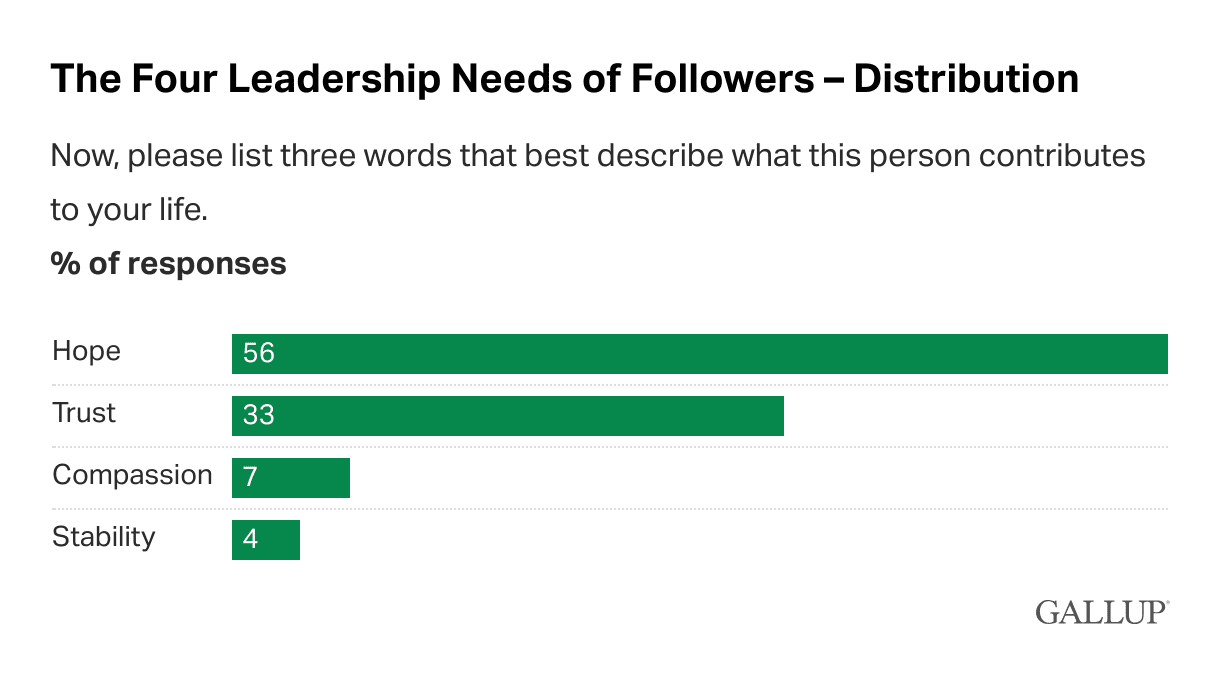
Gallup poll on Leadership skills for Followers
Practical Applications for Today’s Leaders
The research, combined with insights from these leading voices, provides a roadmap for leadership development:
Engineer Hope (56% of impact): Like Badminton’s “Hope Engineers,” leaders can build hope through well-informed strategies and audacious goals. As Moss proves, hope is a hard skill that drives human sustainability and organizational resilience.
Practice Positive Realism (33% of impact): Following Kreek’s discipline, establish trust through consistent optimism balanced with realistic acknowledgment of challenges. Like Lindhout’s experience shows, even in adversity, conscious choice-making builds credibility.
Embrace Productive Discomfort: Use Kreek’s framework to help teams explore negativity and learn from difficult emotions while maintaining compassionate leadership. And Jagdeo’s approach to curiosity as a leading indicator towards hope, even when times are challenging.
Cultivate Daily Practices: Implement Lindhout’s approach of finding gratitude in small things and using intentional self-talk to maintain hope and stability during uncertainty.
- Create Connection Through Compassion: Following Amie Varley’s guidance, take time to truly listen to others, respect and value different opinions, and maintain compassion even when teams are stressed and on edge. Recognize our humanity in difficult circumstances.
The Business Case for Human-Centered Leadership
When leaders meet these four fundamental needs, they create environments with:
- Reduced employee frustration
- Improved organizational wellbeing
- Enhanced team performance
- Greater resilience during challenges
Looking Forward: From Cynicism to Hope
As Jennifer Moss observes, “The workforce has made a huge shift from empathetic to cynical over the last few years. If leaders care about employee well-being and the success of their firms, they must place rebuilding trust and hope at the top of their strategic agendas.”
This shift makes the Gallup findings even more urgent. The leaders who will thrive are those who understand that hope isn’t wishful thinking—it’s engineering. Like Badminton’s vision of Hope Engineers, they’ll create “a well-informed strategy with audacious goals, to carve pathways forward through the greatest challenges we see, and to energize agency in ourselves, those around us and in the allies we choose to stand with.”
As we navigate an increasingly complex global landscape, the speakers who are already embodying these principles—Moss, Lindhout, Allison, Kreek, Jagdeo, Strombo, Archibald-Varley, and Badminton—are modeling the future of leadership where hope becomes the foundation for everything else.
Ready to transform your organization’s leadership approach? Connect with world-class speakers who embody these four essential leadership qualities and can help your team build the foundation for lasting success.
Refresher: Featured Leadership Speakers above:
Hope Builders: Jennifer Moss (Burnout Expert/”Hope is a Hard Skill”) • Amanda Lindhout (Kidnapping Survivor/Humanitarian Leader) • Nik Badminton (Futurist/”Hope Engineers”) • Fenton Jagdeo (Curiosity Compass/Interactive Expert)
Trust Foundation: David Allison (Valuegraphics Creator) • George Stroumboulopoulos (Media Veteran/Authentic Connection) • Pamela Barnum (Trust Strategist/Body Language Expert)
Compassion & Stability: Adam Kreek (Olympic Gold/”Positive Realism”) • Amie Varley (Healthcare Leader/”Connecting Through Compassion”)